
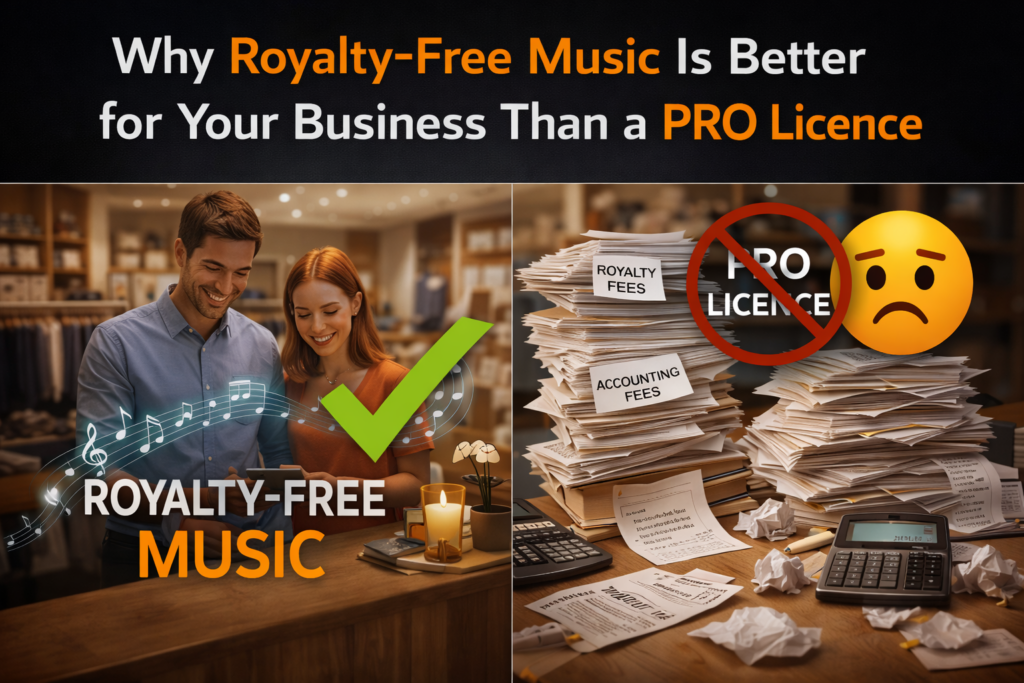
Why Royalty-Free Music Is Better for Your Business Than a PRO Licence
Every business that plays music on its premises faces a choice: pay ongoing fees to a performing rights organisation, or switch to royalty-free music and pay nothing beyond a simple subscription. For most businesses, the choice is clear — but many owners do not realise the option exists.
What Is a PRO Licence and Why Do You Need One?
A performing rights organisation (PRO) is a body that collects and distributes royalties on behalf of songwriters, composers and music publishers. When you play commercially released music in your business — whether via the radio, a streaming service, or your own playlist — you are legally required to hold a licence from your country's PRO.
The most well-known PROs worldwide include:
Playing music without the appropriate licence exposes your business to fines, legal notices and in some countries, court action. PRO inspectors visit commercial premises regularly — particularly in the hospitality, retail and fitness sectors. The financial consequences of non-compliance can far exceed the cost of a licence.
The Real Cost of a PRO Licence
PRO licence fees are calculated based on a range of factors — the size of your premises, the number of locations, your annual turnover, and the type of business you operate. For a small single-location business the annual cost may be manageable. For a retail chain or hotel group, the cumulative cost across all locations can be substantial.
Beyond the direct cost, PRO licences come with administrative overhead — annual renewals, declarations of use, potential audits and the general complexity of dealing with multiple organisations if you operate in multiple countries. A business with locations in Spain, the UK and Germany must hold separate licences with SGAE, PRS and GEMA respectively.
"A mid-sized retail chain operating in five European countries may be paying five separate PRO licences — each with its own renewal process, fee structure and compliance requirements."
What Is Royalty-Free Music?
Royalty-free music is music where the rights holder — the composer, producer and publisher — is a single entity that has chosen to license its music for commercial use without requiring ongoing royalty payments. The term "royalty-free" does not mean the music is free to use; it means there are no royalties owed to third parties beyond the initial licence fee.
When a company produces its own original music exclusively — owning 100% of the composition, performance and master rights — that music can be licenced for commercial use worldwide without any PRO involvement. There are no third-party rights holders to collect fees on behalf of.
This is the model that MF Records has operated since 1999 — producing original music exclusively under its own labels, with full ownership of every track in the catalogue. No sample clearances, no co-writers, no third-party publishers. Every track is created, owned and licenced by a single entity.
Royalty-Free vs PRO Licence — A Direct Comparison
| Factor | PRO Licence | Royalty-Free Music |
|---|---|---|
| Annual cost (1 location) | €200 – €500+ depending on country and size | €72 – €84 per year (xs-4.com) |
| Multiple locations | Separate fee per location, per country | Single subscription covers agreed number of locations |
| International coverage | Separate licence required per country | Worldwide coverage under one subscription |
| Administrative burden | Annual renewals, declarations, potential audits | Automatic renewal, no declarations required |
| Music selection | Access to mainstream commercial releases | Professionally curated channels for business use |
| Proof of compliance | PRO licence certificate | Invoice serves as official licence certificate |
| Price transparency | Complex fee calculations, variable rates | Fixed monthly or yearly price, no surprises |
| Cancellation | Annual commitment, complex exit process | Cancel anytime |
The Quality Argument — Does Royalty-Free Mean Lower Quality?
This is the most common misconception about royalty-free music — that it is somehow inferior to commercially released music. The reality is more nuanced.
Royalty-free music produced by a dedicated music label with professional studios, experienced composers and decades of production history is indistinguishable in quality from commercially released music. What it lacks is the marketing budget and radio airplay of mainstream artists — which for background music in a business environment is completely irrelevant.
Customers in your store, hotel or restaurant do not need to recognise the music. They need to feel something — comfortable, relaxed, energised, or sophisticated depending on your environment. That emotional response comes from production quality, musical craft and appropriate curation — not from chart position.
MF Records has been producing original music since 1999, with tracks that have appeared in international charts on platforms including iTunes and Beatport. The catalogue of over 3250 tracks is streamed more than 9.5 million times per month across 36 countries — by businesses that have chosen quality and legal simplicity over mainstream familiarity.
When a PRO Licence Still Makes Sense
Royalty-free music is not the right solution for every situation. There are scenarios where a PRO licence remains the appropriate choice:
- Live music events — if your venue hosts live performances of commercially released music, a PRO licence is required regardless of your background music choice
- Broadcasting and advertising — if you produce video content, advertisements or broadcast media using commercially released music, PRO licences and synchronisation licences apply
- Brand-specific music identity — if your brand is built around a specific well-known artist or song, that association requires a traditional licence
For the vast majority of businesses using background music in a commercial environment — retail stores, hotels, restaurants, cafés, gyms, spas, salons — royalty-free music is the legally sound, financially superior and operationally simpler choice.
How to Switch to Royalty-Free Music
Switching from a PRO licence to royalty-free background music is straightforward. The process typically involves three steps:
1. Choose a royalty-free music provider
Select a provider whose catalogue and channel curation matches your business environment. Verify that the provider owns 100% of the rights to its music — ask for documentation confirming that no third-party PRO fees apply worldwide.
2. Obtain your licence documentation
Your subscription invoice should explicitly confirm that the music is royalty-free and that no performing rights fees apply. This document is your proof of compliance if your premises are ever inspected by a PRO representative.
3. Notify your PRO
If you currently hold a PRO licence, inform the organisation that you are switching to royalty-free music and will not be renewing. Keep a copy of your royalty-free licence documentation on your premises.
Conclusion
The case for royalty-free business music is compelling on every measure — cost, simplicity, international coverage and legal clarity. For businesses operating in multiple countries or across multiple locations, the advantages are even more pronounced.
The music produced by MF Records since 1999 represents a quarter century of original composition, professional production and curated excellence — available to any business worldwide through XS-4 Business Audio for a single flat monthly fee. No PRO fees. No surprises. Just the right music, legally and affordably.
Hear It Before You Subscribe
Listen to 3 tracks from each of our 10 curated channels — completely free, no registration required.
Try the Free Demo About MF Records